
The automotive turbine system and cooling water circuit belong to the complex pipeline system in vehicle operation, which is subjected to long-term temperature alternation and dynamic pressure fluctuations. They have strict assembly requirements for the pipe wall structure, pressure bearing capacity, and deformation resistance of the supporting hoses. The structure of ordinary single-layer and double-layer silicone hoses is relatively simple. Under the long-term effects of continuous high pressure, negative pressure adsorption, and high temperature environment, it is easy to encounter problems such as pipe wall expansion, pipe flattening, channel blockage, surface aging and damage, which affect the normal operation of vehicle cooling cycle and turbine system. This four layer composite silicone braided hose is made using a multi-layer stacking composite process, relying on the combination structure of inner layer silicone, multi-layer polyester fiber braided interlayer, and outer layer silicone to optimize the overall physical properties of the pipe wall. It is suitable for high temperature and high pressure conventional working conditions of automotive turbines and cooling water circuits, as well as various vehicle pipeline modification and original factory pipeline replacement scenarios.
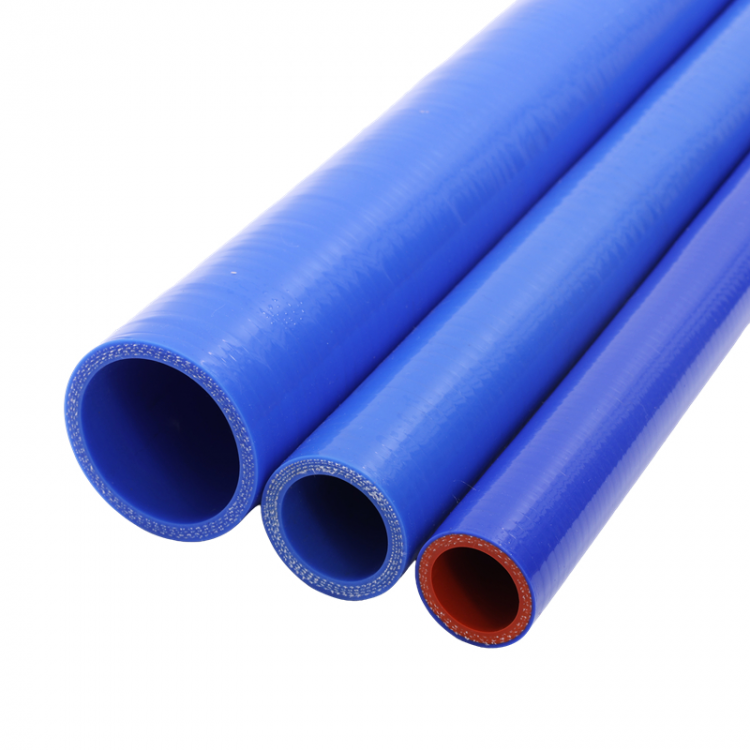
The product adopts a four layer integrated composite molding process, consisting of an inner layer of silicone, a double-layer polyester fiber woven interlayer, and an outer layer of silicone combination. The multi-layer structure is tightly integrated and molded as a whole, with no layering gaps or local weak areas on the pipe wall, and the overall structural integrity is stable. Compared with conventional double-layer and three-layer structure hoses, the stacked four layer composite structure can effectively increase the overall thickness and structural compactness of the pipe wall, optimize the stress structure of the pipe wall, improve the problem of insufficient pressure and easy deformation of ordinary hoses, and enable the pipe to maintain a stable shape under complex pipeline conditions, adapting to the continuous operation needs of vehicles.
Polyester fiber woven interlayer is the core structure that improves the performance of pipe materials. The double-layer woven layer is evenly arranged between the inner and outer silicone layers, and the fibers are interwoven in a neat and orderly manner with uniform density, which can provide all-round structural support for the pipe wall. During the process of pressure rise inside the pipeline, the woven interlayer can share the tension borne by the pipe wall, constrain the expansion amplitude of the silicone layer, alleviate the pressure expansion of the pipe wall, and adapt to the pressure fluctuation conditions of cooling water and turbine pipelines. When negative pressure suction is generated in the pipeline, the dense woven structure can provide stable support, reduce the inward contraction of the pipe wall and the flattening of the pipeline, ensure that the internal medium flow channel of the pipeline remains unobstructed, and avoid water flow and airflow blockage caused by pipeline deformation.
Both the inner and outer layers are made of high-quality silicone material, suitable for the use environment of high-temperature pipelines in vehicles. The inner layer of silicone gel is delicate and dense, with a flat and smooth inner wall. It has good compatibility with coolant and airflow media, and is not prone to swelling, corrosion, peeling, etc. It can reduce the resistance of medium circulation, lower the probability of impurity adhesion and accumulation, and maintain the smoothness of pipeline circulation even after long-term use. The outer layer of silicone has good temperature resistance, oxidation resistance, and aging resistance, which can adapt to the high temperature environment around the engine, resist air oxidation, slight oil spills, and losses caused by daily temperature differences, delay the aging, discoloration, hardening, and cracking of the pipe, and effectively extend the service life of the pipeline.
After four layers of composite process optimization, the overall structural strength of the pipe wall has been effectively improved, and its physical endurance performance is suitable for the harsh working conditions of automotive turbine systems and cooling water circuits. During the driving process of the vehicle, the pipeline will generate continuous vibration along with the engine operation, while facing frequent switching of hot and cold temperatures and dynamic changes in pipeline pressure. This composite hose relies on a solid multi-layer structure to adapt to such normal working conditions, and is not prone to fatigue deformation, local damage and other problems. It continuously provides stable pipeline support for the vehicle's water and gas circulation, and is suitable for various driving scenarios such as daily commuting and complex road conditions.
In practical assembly and use, this hose has a wide range of adaptability and can be used for the modification of automotive turbine inlet and outlet pipelines, cooling system circulation pipelines, and matching high-temperature and high-pressure pipelines, as well as the replacement of old pipelines. In response to the problem of the original vehicle's ordinary pipelines being unable to adapt to high temperature and high pressure conditions and frequently experiencing deformation and failure, this four layer composite hose can be used as a replacement upgrade accessory to optimize the operational stability of the vehicle's pipeline system. The pipe has good bending performance and can be adapted to multi angle wiring and narrow space bending installation in the cabin. After bending, there will be no closure of the pipe wall or blockage of the passage, which meets the original factory pipeline layout and modification wiring requirements of most car models.
The overall production process adopts an integrated composite molding method, which avoids structural defects caused by later bonding and splicing. The thickness of the pipe wall is uniform, the stress is balanced, and the tolerance range is wider. For car owners and maintenance personnel, replacing and adapting this multi-layer structure silicone hose can reduce the frequency of pipeline failures and lower the maintenance costs of later pipeline maintenance and replacement. It is a highly practical accessory for repairing and retrofitting high-temperature and high-pressure pipelines in automobiles, and can meet the assembly and use needs of most fuel vehicle pipeline systems.