
Address: Home > News > Technical Documentation >
135 ° molded silicone tube bending mold forming process and structural dimension description
Time:2026-08-05 11:46:49 Author:Lingyongtai Clicks:110Second-rate
1 Document Overview
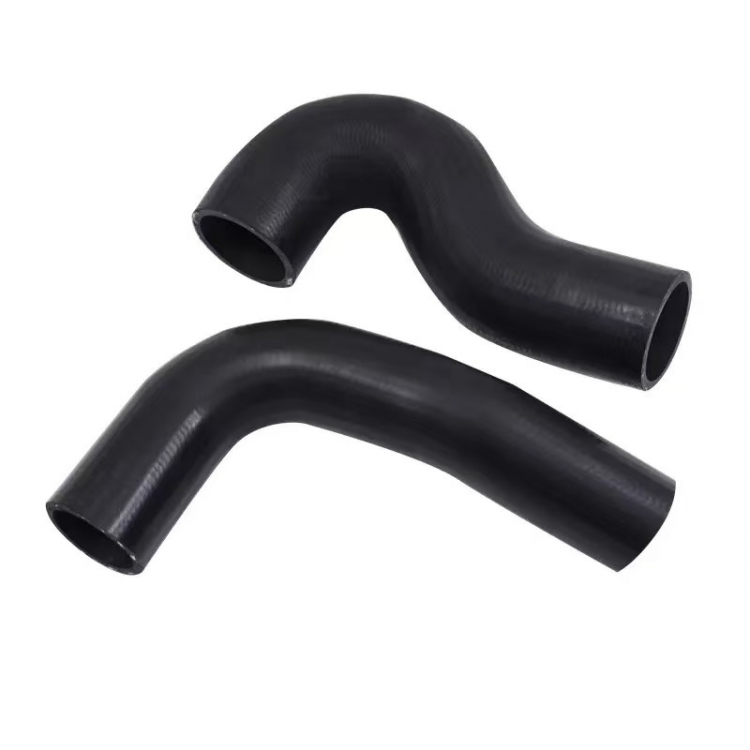
This document records the complete process flow of the 135 ° molded silicone bend tube mold processing and vulcanization molding, and also standardizes the product's general structural dimensions, pipe wall layering structure, and corner molding standards. It is suitable for workshop production quality inspection, component warehousing inspection, and equipment pipeline matching selection reference. This type of bend pipe is commonly used for vehicle intercooler pipelines, cooling water circuits, and high-temperature fluid oblique transfer points in construction machinery. It relies on mold shaped obtuse angle structures to replace on-site hose bending and multi tube splicing assembly methods. The document only objectively records the process flow and dimensional parameters, without subjective performance exaggeration.
2 Mold Design and Processing Flow
The 135 ° silicone bend pipe is produced using a split combination metal mold for shaping. The mold is divided into three parts: the inner core mold, the outer forming mold, and the two end limit card mold. All of them are CNC machined according to the 135 ° obtuse angle, straight pipe length, and transition arc radius marked on the drawing. Reserved space for layered material laying in the inner cavity of the mold, corresponding to the thickness of the multi-layer sandwich composite structure of the pipe material. Smooth chamfering treatment is applied to the corner area of the mold cavity to avoid the occurrence of thin wall thickness and wrinkled accumulation at the corner position of the pipe wall after vulcanization.
After the mold processing is completed, it is necessary to perform mold closing verification, check the angle of the angle, the diameter of the inner cavity, and the depth of the pipe end limit, confirm that the width of the joint gap is within a controllable range, and avoid excessive overflow of the rubber material during the vulcanization process, which increases the workload of later trimming. Before the qualified mold is put into use, a release agent will be evenly applied inside the mold cavity, and after being left to air dry, it will enter the material laying process. The entire mold is matched with fixed vulcanization equipment, and a single tube can be formed in one piece without segmented bonding or secondary shaping processes.
3. Integrated molding and vulcanization process
The production process includes silicone mixing and cutting, fiber interlayer laying, mold filling and clamping, constant temperature vulcanization, cooling demolding, edge trimming, and size sampling. The operator lays the inner layer of silicone, fiber woven interlayer, and outer layer of silicone in the order of pipe wall layering. The three layers of materials are aligned and placed on the outside of the inner core mold, and then the outer mold is closed to complete the mold locking and fixation.
The equipment maintains a constant temperature zone to complete the vulcanization reaction, allowing the silicone raw material to fuse and solidify with the fiber interlayer, and combining the three-layer structure into a complete pipe. After vulcanization, the mold is naturally cooled to room temperature. The mold is disassembled to take out the formed pipe, and excess material at the pipe mouth and corners is manually cleaned to ensure that the outer contour and inner hole channel of the pipe are smooth and even.
The whole forming process relies on the mold to fix the 135 ° obtuse angle shape. The bending angle of the finished product will not deviate significantly with the change of external force and temperature. The included angle, pipe diameter and straight pipe length of the pipes produced by the unified mold will be kept in a unified range, which is suitable for the requirements of batch supporting production.
4. Overall structure and construction of the product
The pipe is a three-layer composite structure, with the inner layer of silicone directly in contact with cooling liquid, pressurized airflow and other media, and the surface layer free of protruding particles; The middle fiber weaving interlayer is arranged in a staggered manner, evenly distributed in the middle of the pipe wall, to share the deformation tension caused by pressure fluctuations in the pipeline; The outer layer of silicone isolates oil, air, and water vapor from the cabin, forming a protective coating for the internal interlayer.
The 135 ° obtuse angle corner is the transition section for integrated molding of the mold. The inner and outer arcs of the corner are designed symmetrically, and the difference between the pipe wall thickness and the straight pipe section is controlled within a reasonable range, without local thinning. Reserved straight pipe sections at both ends of the pipe are used for pipe clamp wrapping and fixation. The length of the straight pipe section is uniformly matched with the size of conventional fasteners in the market, making it convenient for on-site assembly and locking. The internal channels of the pipe are continuous and uniform throughout the entire process, without any shrinkage or protrusions that obstruct the flow of the medium.
5 General Structural Dimensional Specifications
The document lists the conventional size standards for 135 ° molded silicone bend pipes in circulation on the market, with core control parameters including inner diameter, total thickness of pipe wall, length of single-sided straight pipe section, radius of corner transition arc, and 135 ° angle tolerance range.
The inner diameter is divided into multiple standard gears, suitable for various types of vehicles and engineering machinery pipeline interfaces; The pipe wall distinguishes between conventional thickness and thickened composite specifications, which can correspond to different working pressure conditions; Multiple standard values are set for the length of the straight pipe section to adapt to different installation distances in the engine room. Set a fixed tolerance range for the angle, and control the angle deviation of the finished product within a limited range after mold shaping to meet the requirements of oblique pipeline docking.
All dimensional parameters are marked on the mold drawings and product labels. During selection and quality inspection, calipers and angle rulers can be used for actual measurement and comparison. Products with dimensions exceeding the tolerance range are classified and do not flow into the assembly process.
6. Matching role of process and size control
The standardized mold forming process, combined with uniform size specifications, can reduce the adjustment process during pipe assembly. The 135 ° obtuse angle can be adapted to the inclined wiring points of the equipment, reducing the contact friction between the pipeline and the surrounding shell and wire harness. The integrated structure has no splicing gaps, and is compatible with standardized pipe wall thickness to adapt to the operating environment of alternating cold and hot in cooling and intake systems, as well as continuous vibration.
The production process relies on mold control to shape the product, completes factory screening based on size standards, stabilizes the structural form of the finished product, adapts to long-term assembly and use of fluid pipelines in vehicles and engineering machinery, and provides standardized matching fittings for pipeline diagonal transfer points.